
New Delhi, Health Desk | WEBVARTA
Planning a family involves more than preparing for pregnancy and childbirth. It also means understanding the medical expenses that may arise during pregnancy, delivery and newborn care. Maternity health insurance can help manage some of these costs, but the benefits are not identical across policies. Waiting periods, delivery limits, hospitalisation conditions and newborn coverage can vary considerably between insurers.
One of the most common mistakes is assuming that an ordinary health insurance policy automatically covers pregnancy and childbirth. In many cases, maternity benefits are available only through selected plans or optional add-ons. Some policies also impose waiting periods that must be completed before a maternity claim becomes eligible. Reviewing these conditions before planning a pregnancy can help families avoid unexpected expenses later.
- Subject: Maternity health insurance in India
- Key concern: Coverage for pregnancy, delivery and newborn care
- Important condition: Waiting periods may apply
- Delivery coverage: Check normal delivery and C-section benefits separately
- Additional expenses: Prenatal tests, postnatal care and NICU treatment may have separate conditions
- Before purchasing: Read the policy wording and Customer Information Sheet
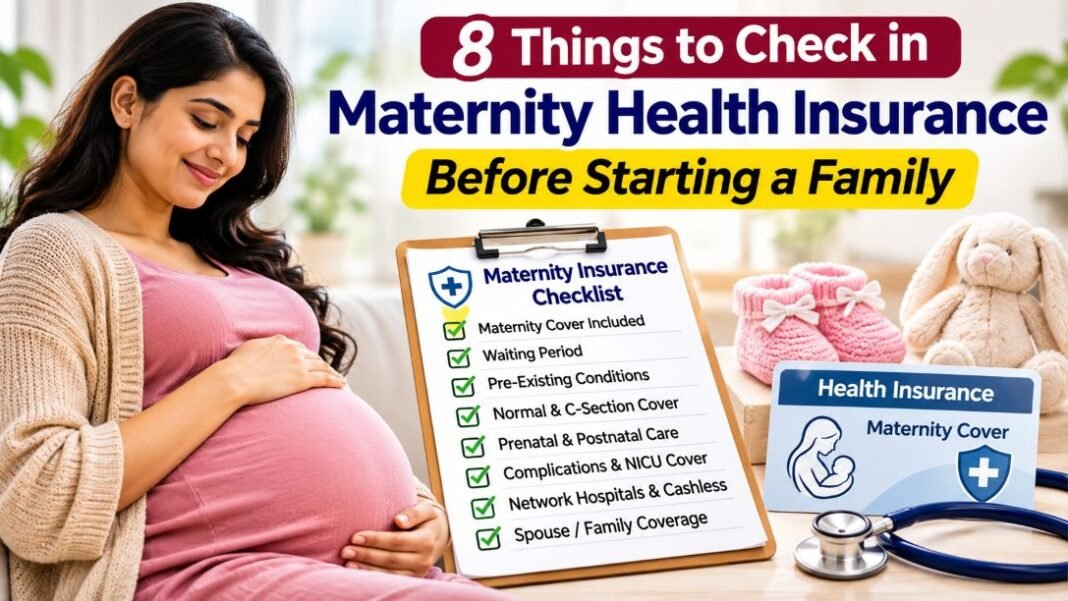
1. Does Your Health Insurance Policy Include Maternity Cover?
Having health insurance does not necessarily mean that pregnancy-related expenses are covered. Some policies include maternity benefits as part of the main plan, while others offer them through an optional rider or add-on. Certain policies may not provide maternity benefits at all.
Start by checking the policy schedule and the section dealing with maternity expenses. Look for the specific amount payable for childbirth, the eligibility conditions and any exclusions.
Do not rely only on a sales representative’s verbal explanation. Ask the insurer to confirm whether the policy covers hospitalisation for delivery, medically necessary procedures and any associated complications. If maternity cover is available only through an add-on, check whether it must be purchased at the time of taking the base policy or can be added later.
2. Understand the Maternity Insurance Waiting Period
The waiting period is one of the most important conditions to examine before buying maternity insurance. It refers to the period during which a policyholder must remain insured before becoming eligible to claim a particular benefit.
There is no single waiting period that applies to every maternity insurance product in India. The duration depends on the insurer, policy and benefit selected. Some products specify a waiting period of nine months, while other plans and riders can require a considerably longer period.
For example, New India Assurance’s published Maternity Rider lists waiting periods of 36 months for certain sum-insured categories and 12 months for higher sum-insured categories. This illustrates why buyers should check the exact product conditions rather than assume that every policy follows the same timeline.
Also confirm when the waiting period begins, whether it applies to every insured member and whether continuity benefits are available when switching or renewing policies.
3. Check How Pre-Existing Medical Conditions Are Treated
Medical conditions that existed before purchasing a policy can affect coverage and claim eligibility. Depending on the policy terms, conditions such as diabetes, thyroid disorders, hypertension or PCOS may require disclosure during the application process.
However, it would be incorrect to assume that every pre-existing condition automatically makes a pregnancy-related claim ineligible. The outcome depends on the policy’s definition of pre-existing disease, applicable waiting periods, exclusions and the medical circumstances involved.
Before purchasing a plan, ask the insurer how it treats pregnancy complications associated with a previously diagnosed condition. Also clarify whether gestational diabetes or pregnancy-induced hypertension would be assessed differently from a condition that existed before the policy began.
Disclose relevant medical history accurately. Obtain written clarification wherever possible, especially if the insurer has imposed a specific condition or exclusion on the policy.
4. Does the Policy Cover Both Normal Delivery and C-Section?
Delivery expenses can differ depending on the medical procedure required. A vaginal delivery and a caesarean section may involve different hospital charges, surgical expenses and recovery requirements.
Check whether the policy covers both types of delivery and whether separate financial limits apply. Some policies specify one maternity limit for all eligible delivery expenses, while others may have separate sub-limits for normal delivery and C-section.
For example, a policy may advertise maternity coverage of ₹1.5 lakh, but that does not necessarily mean the entire amount will be payable in every situation. Room-rent restrictions, hospitalisation conditions, exclusions and other limits can reduce the admissible claim.
Compare the available benefits with the estimated charges at the hospital where you are likely to seek treatment. A higher maternity limit may be useful, but it should be assessed alongside the premium and other policy conditions.
5. Are Prenatal and Postnatal Expenses Included?
Maternity-related medical care begins well before delivery and can continue after the baby is born. Regular consultations, blood tests, ultrasound scans and medically required investigations may form part of the pregnancy care process.
However, maternity insurance does not automatically cover every expense incurred during these stages. Some plans restrict benefits to hospitalisation for delivery, while others may provide a separate allowance for prenatal and postnatal care.
Check the policy wording for the following expenses:
- Obstetrician and gynaecologist consultations
- Ultrasound scans and pregnancy-related investigations
- Blood tests and diagnostic procedures
- Hospitalisation before delivery, where medically necessary
- Post-delivery medical consultations and treatment
- Prescribed medicines and other eligible medical expenses
Pay particular attention to outpatient expenses. A policy that covers hospitalisation may not reimburse routine consultations or tests conducted without admission to a hospital.
6. Check Complications, Newborn Benefits and NICU Coverage
Pregnancy and childbirth may sometimes require additional medical attention. Complications can lead to longer hospital stays, specialised treatment or intensive care for the mother or newborn baby.
Do not assume that maternity coverage automatically includes every expense associated with complications. Ask whether medically necessary treatment for pregnancy-related complications is covered under the maternity benefit or the main hospitalisation cover.
Newborn benefits also deserve separate attention. Some policies provide limited cover for a baby from birth, while others require the child to be added to the policy within a specified period. Conditions may apply to newborn hospitalisation, congenital conditions, vaccinations and treatment after the initial coverage period.
For families concerned about premature birth or neonatal intensive care, the insurer should clarify the following points:
- Whether newborn hospitalisation is covered from the date of birth
- Whether NICU treatment is included and under which benefit
- Whether the newborn shares the mother’s maternity limit or receives a separate limit
- Whether premature birth and related treatment are covered
- How long newborn coverage continues after delivery
- What procedure and deadline apply for adding the baby to the policy
These details matter because newborn treatment may involve expenses beyond the delivery benefit. The precise coverage must be confirmed from the policy schedule and wording.
7. Confirm Hospital Network and Cashless Treatment Availability
The hospital you prefer should be considered before choosing a maternity insurance plan. Insurers maintain hospital networks where eligible policyholders may access cashless treatment, subject to policy terms and approval procedures.
Check whether your preferred maternity hospital is included in the insurer’s current network. Do not depend entirely on an old hospital list, because network arrangements can change.
Also confirm whether maternity treatment is eligible for cashless admission at that hospital. Cashless treatment is not an unconditional guarantee that every bill will be paid. The insurer or its authorised administrator assesses the request according to the policy terms, medical necessity and available coverage.
If the hospital is outside the network, ask whether reimbursement is permitted and what documents will be required. Clarify the pre-authorisation procedure and the process for planned hospital admission so that there is less uncertainty when treatment is needed.
8. Review Spouse Coverage and Family Floater Benefits
Families buying health insurance together should examine how maternity benefits work under a family floater policy. A family floater generally provides a shared sum insured for the members covered under the plan, but maternity benefits may have additional eligibility conditions.
Check whether both spouses are eligible for the maternity benefit, whether the woman who may claim the benefit must be specifically included as an insured member and whether the policy imposes age or family-size restrictions.
Also find out whether maternity expenses reduce the shared sum insured available for other medical claims. Some policies have a separate maternity limit, while others make payments within the overall sum insured.
Before finalising the plan, compare the premium for individual and family floater options. A lower premium does not necessarily mean better maternity protection if the policy has restrictive sub-limits or a longer waiting period.
| What to compare | What to verify |
|---|---|
| Maternity benefit | Whether it is included or available as an add-on |
| Waiting period | Exact duration and commencement date |
| Delivery expenses | Normal delivery and C-section limits |
| Medical history | Pre-existing disease conditions and exclusions |
| Pregnancy care | Prenatal and postnatal expenses |
| Newborn treatment | Newborn hospitalisation and NICU benefits |
| Hospital network | Preferred hospital and cashless eligibility |
| Family floater | Spouse eligibility and shared sum insured |
What Should You Do Before Buying Maternity Insurance?
Before purchasing a policy, compare at least two or three suitable products and read their complete policy documents. The Customer Information Sheet can help identify major benefits, waiting periods, exclusions and limits, but it should be read alongside the full policy wording.
Ask the insurance company for written answers to questions about maternity eligibility, delivery limits, newborn treatment and complications. If you already have a health insurance policy, check whether maternity benefits are included before purchasing another plan.
It is also important to understand that buying a policy after pregnancy has begun may not make that pregnancy eligible for maternity benefits. The applicable waiting period and policy commencement conditions must be checked before making a purchase decision.
- Policy schedule and certificate of insurance
- Complete policy wording
- Customer Information Sheet
- Maternity rider or add-on document, if applicable
- List of network hospitals
- Written clarification from the insurer about specific coverage questions
Final Word: Plan Insurance Before You Need It
Maternity health insurance can provide financial support for eligible pregnancy and childbirth expenses, but the value of a policy depends on its actual benefits and limitations. A plan with a higher advertised sum insured may still have a restrictive maternity sub-limit, while a policy offering newborn cover may impose separate eligibility conditions.
The most practical approach is to review maternity benefits well before planning a pregnancy, understand the waiting period, disclose medical history accurately and confirm the treatment limits in writing. Taking time to compare policies can help families make a more informed decision and prepare financially for the arrival of a child.
- Confirm that maternity cover is actually included.
- Check the exact waiting period.
- Understand pre-existing disease conditions.
- Compare normal delivery and C-section limits.
- Verify prenatal and postnatal benefits.
- Check newborn and NICU coverage separately.
- Confirm hospital network and cashless arrangements.
- Review spouse eligibility and family floater limits.
Also Read
Disclaimer: This article is intended for general information and consumer awareness. It does not constitute insurance, financial or medical advice. Maternity benefits, waiting periods, exclusions and claim limits differ between insurance products and may change. Always check the latest policy wording, Customer Information Sheet and insurer’s written clarification before purchasing a policy. For regulatory information, visit the Insurance Regulatory and Development Authority of India (IRDAI).