

Fifth June Friday was observed as world environment day – The global campaign, spearheaded by the UN Environment programme (UNEP) focused intensely on urgent climate action to mitigate rising global temperatures.
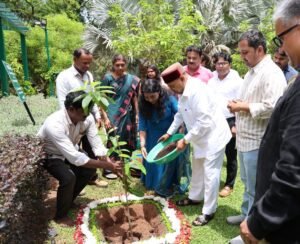
Hon’ble Governor of Karnataka Thaawarchand Gehlot planted a Rudraksha sapling at the Lok Bhavan premises on the occasion of World Environment Day.
Prime Minister Narendra Modi had specifically focused on the potential impact of El Nino conditions and stressed the need for states to focus on water conservation measures. El Nino is a periodic warming of waters in the central and eastern Pacific Ocean, and is generally associated with weaker monsoon rains over India.
The World Meteorological Organisation (WMO) has already warned that an El Nino event is expected to develop from mid-2026 and influence weather patterns worldwide. His remarks come at a time when weather experts around the world are closely monitoring the development of El Nino, a climate phenomenon associated with warmer-than-normal sea surface temperatures in the equatorial Pacific Ocean that can influence rainfall patterns across several regions, including India.
According to Japan’s meteorological authorities, sea surface temperatures across the equatorial Pacific have remained warmer than average, signalling the onset of El Nino conditions that are expected to continue through the Northern Hemisphere’s autumn season.
For India, El Nino is often associated with weaker monsoon rainfall, prolonged heatwaves and an increased risk of drought. The phenomenon can disrupt the southwest monsoon by reducing the strength of moisture-laden winds that normally bring widespread rains to the country. The Prime Minister’s caution on climate risks formed part of a broader agenda focused on building a developed India, or “Viksit Bharat,” through cooperative federalism and long-term planning. Modi noted that despite economic uncertainty affecting many major economies, India’s growth story continues to inspire the world.
He had urged states to strengthen the country’s journey towards self-reliance by adopting global best practices, particularly in renewable energy and emerging technologies.
Dr. Abdus Salam former CEO of Markaz Knowledge City said – A Rudraksha plant Absorbs CO₂ and releases oxygen through photosynthesis, like any large tree.
– Its broad leaves trap airborne dust and particulate matter (PM) on their surface, reducing local dust load.
– Provides shade, lowers ambient temperature, and supports humidity — indirect cooling that reduces smog formation.
– Mature trees can absorb some gaseous pollutants (SO₂, NOₓ) along with other urban trees.
The Rudraksha plant, scientifically known as Elaeocarpus ganitrus, is valued for its spiritual, environmental, and medicinal significance.
Benefits of the Rudraksha Plant
1. Spiritual Importance
- The seeds (Rudraksha beads) are traditionally associated with Lord Shiva.
- Used for meditation, prayer, and spiritual practices.
- Many people believe Rudraksha beads help improve concentration, peace of mind, and emotional balance.
2. Environmental Benefits
- Acts as an excellent oxygen-producing tree.
- Helps reduce air pollution and improve local air quality.
- Provides shade and supports biodiversity by attracting birds and insects.
- Contributes to soil conservation and ecological balance.
3. Medicinal and Traditional Uses
- In traditional Ayurvedic practices, different parts of the tree are used for various remedies.
- The fruit pulp contains antioxidants and beneficial plant compounds.
- Leaves and bark have been used in folk medicine for fever, skin ailments, and digestive issues (scientific evidence varies).
4. Economic Value
- Mature trees produce Rudraksha beads that are widely used in jewelry and religious items.
- High-quality beads can have significant market value.
- Suitable for cultivation as a long-term agroforestry crop in appropriate climates.
5. Ornamental Value
- The tree has attractive foliage and fruits, making it suitable for gardens, temples, educational institutions, and parks.
Growing Conditions
- Thrives in tropical and subtropical climates.
- Prefers well-drained soil and moderate to high rainfall.
- Usually starts bearing fruits after 5–8 years, with better yields as the tree matures.
Senior journalist Rakesh Tripathi said many people plant Rudraksha trees not only for their spiritual significance but also because they are environmentally beneficial, long-lived, and aesthetically pleasing.