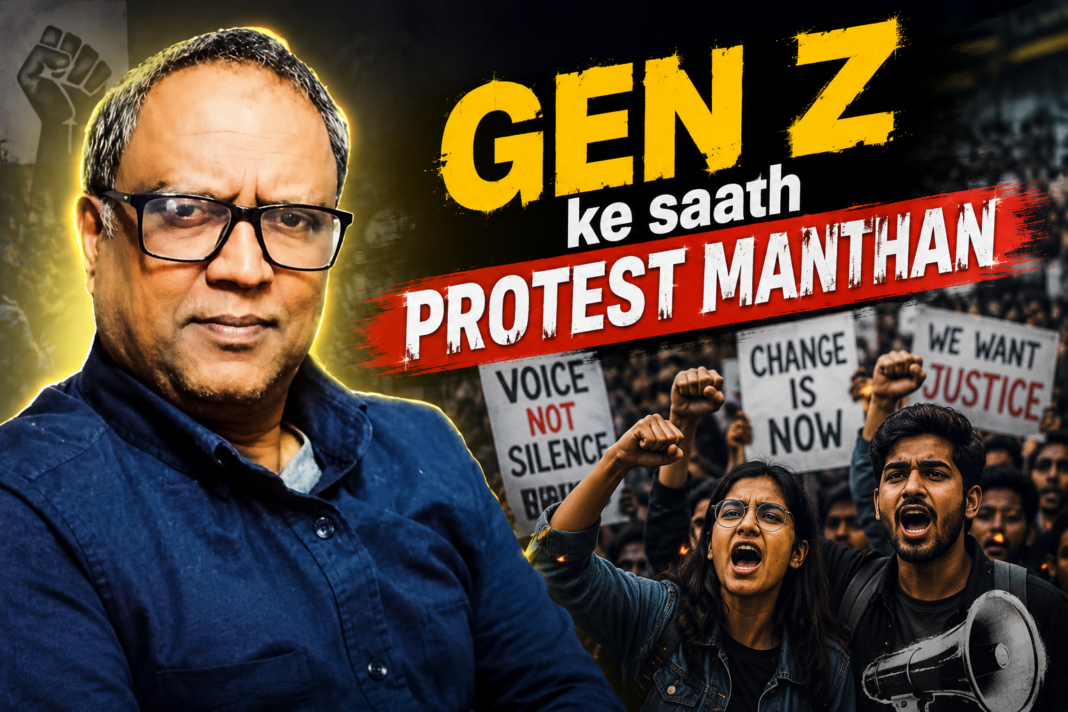
The recent protests at Jantar Mantar, which eventually led to the resignation of a minister from the Modi Cabinet, have sparked a nationwide debate. While political parties attempted to interpret the movement through their own lenses, an important voice emerged from an unexpected quarter — India’s Gen Z.
During an interaction with students of ISOMES, the media academy associated with News24, one thing became immediately clear: India’s young citizens are alert, politically aware, and willing to express their opinions without hesitation. Yet, their views are far more nuanced than the narratives often projected on social media.
The students largely believed that the protest itself was justified. According to them, when opposition parties fail to effectively raise issues in Parliament, citizens naturally seek democratic avenues outside the House. Peaceful protest, they argued, remains a legitimate instrument of public expression in a democracy.
However, the students drew a clear line between protest and personal attacks.
Many of them felt that the aggression directed at the Prime Minister and the use of vulgar language on placards diluted the moral force of the movement. Their argument was simple but powerful: if a protest is rooted in demands for morality, accountability, and discipline, then the language and conduct of protesters must reflect those very values.
“You cannot speak about discipline while using vulgarity,” was a sentiment echoed repeatedly during the discussion.
The students also expressed admiration for social activist Sonam Wangchuk and his hunger strike. They viewed his approach as a powerful example of non-violent democratic engagement. For many of them, peaceful resistance carries greater moral authority than anger-driven confrontation.
An equally interesting observation emerged regarding the digital platform of Dipke and similar youth-driven spaces. The students strongly felt that such platforms should remain non-political and independent. In their view, these spaces derive their credibility from being unfiltered and free from partisan influence.
Many participants said they continue to support Dipke CJP founder. Yet they attached one important condition: the platform should not become a stage for opposition politicians or partisan campaigns. They believe that once political actors dominate the conversation, the authenticity of youth voices is compromised.
Perhaps the most significant takeaway from the interaction was the continuing credibility of Prime Minister Narendra Modi among young Indians.
Contrary to assumptions that Gen Z is uniformly anti-establishment, many students displayed a nuanced respect for the Prime Minister, even while supporting certain protests. His communication through Instagram and other social media platforms appears to be making a deep impression on younger audiences.
The Prime Minister’s recent message on social media has also attracted attention. In that message, he emphasized forgiveness rather than retaliation, suggesting that many young protesters may have been confused or influenced by disruptive elements. He stressed that it is society’s responsibility to guide the youth toward constructive nation-building rather than alienate them.
https://x.com/narendramodi/status/2083245431769989598?s=20
This message appears to resonate with a significant section of Gen Z. The emphasis on engagement rather than confrontation reflects a broader understanding that India’s young population represents an asset, not an adversary. The events surrounding Jantar Mantar offer an important lesson for all stakeholders. Political leaders, activists, and social influencers must recognize that today’s youth are neither passive followers nor ideological foot soldiers. They are independent thinkers capable of supporting a protest while rejecting vulgarity, questioning authority while respecting institutions, and demanding accountability while valuing national stability.
There is also a practical wisdom that cannot be ignored. One student used a striking metaphor: disturbing a beehive is rarely a wise strategy. When emotions are inflamed, escalation often produces consequences that nobody can fully control. Dialogue, restraint, and mutual respect remain the safest paths forward. India’s Gen Z is sending a message that deserves attention. They support democratic dissent but reject abuse. They value activism but oppose vulgarity. They want independent platforms, not political capture. And despite disagreements on specific issues, many continue to place considerable trust in the leadership of Prime Minister Modi.
I tried to speak to Tanuja Shankar the HOD of ISOMES but she said let the performance of my students do the talking. She said my job is to give them the best technological support so that they can be global reporters and put the Indian perspective in their story.
The future of India’s democratic discourse may well depend on how seriously the nation listens to these young voices. Their message is not one of blind support or blind opposition. It is a call for responsible citizenship, civil debate, and constructive nation-building — values that can strengthen both democracy and society