
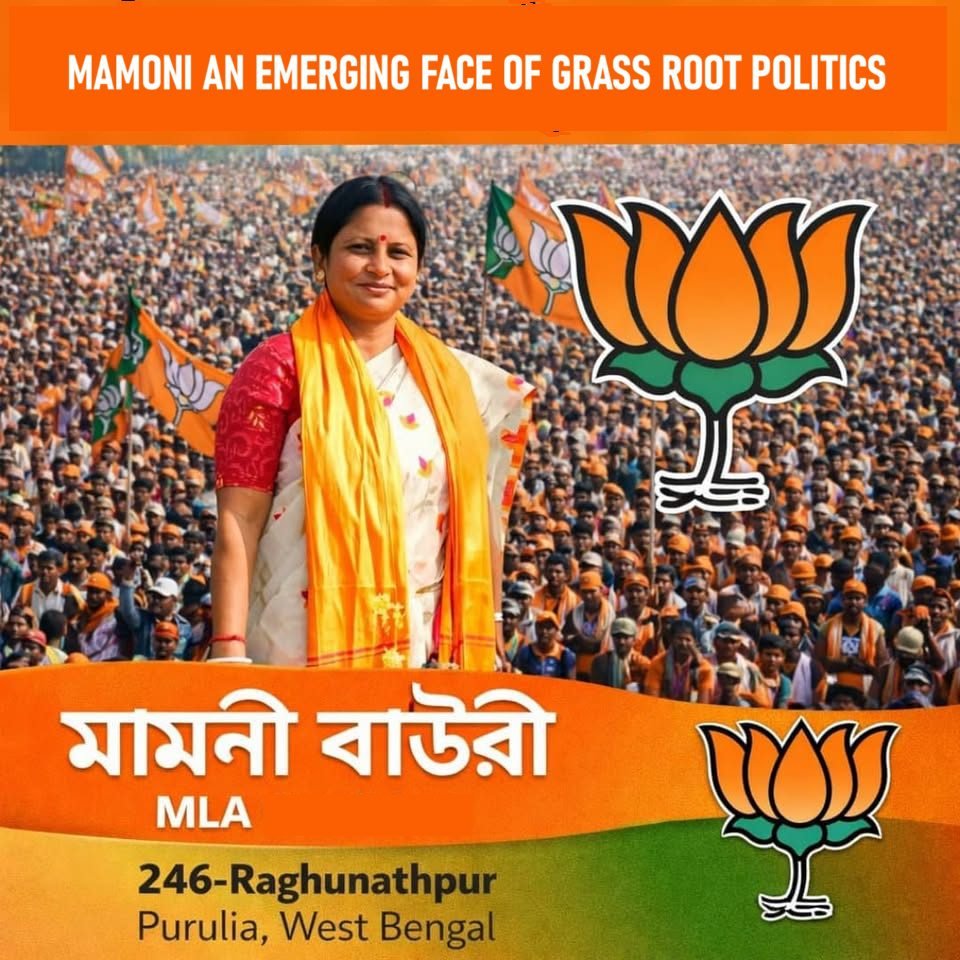
From listening to children, women, Dalit students and labourers to fighting misinformation and addressing youth depression, Mamoni Bauri wants politics to become a direct instrument of social change.
Raghunathpur: Mamoni Bauri’s emphatic victory in Raghunathpur has brought renewed attention to a style of grassroots politics that places public engagement, accessibility and social responsibility at its centre. At a time when political leadership is increasingly judged through social media campaigns and electoral narratives, Mamoni Bauri is attempting to establish her identity as a leader who believes in listening to people on the ground.
Although the BJP’s intensified public outreach and organisational activities have gained momentum only over the past six months, Mamoni Bauri has emerged as a prominent face of its people-centric approach. What makes her stand out is her willingness to make time for almost everyone who approaches her. She connects faith and spirituality with Manav seva. She says under the guidance and supervision of Chief Minister Suvendu Adhikari Bengal will reach new heights.
Children, women, Dalit students, members of OBC and SC communities, street hawkers and daily-wage labourers looking for employment — she believes every individual deserves to be heard. Her approach reflects an understanding that public service is not merely about addressing major political issues but also about responding to the everyday struggles of ordinary citizens.
A grassroots worker with a larger national vision
A strong admirer of Prime Minister Narendra Modi, Mamoni Bauri believes that India’s development journey must reach the last person in society. Her political outlook combines grassroots engagement with a larger national vision of development, social empowerment and public participation.
Her recent interaction with senior journalist and author Sheikh Irfan, founder of the Muslim Gau Raksha Sangh, also reflected her interest in issues beyond conventional electoral politics. Mamoni Bauri was invited to attend the launch of Sheikh Irfan’s forthcoming book on Prime Minister Narendra Modi, titled ID of OM. The book is primarily intended for Generation Z and explores the Prime Minister’s leadership, vision, governance and engagement with India’s younger generation.
Union Minister of State Ramdas Athawale, a prominent Dalit leader from Maharashtra and a member of the Union Cabinet, has agreed to launch the book.
The initiative comes at a time when the role of young people in shaping India’s political and social future is attracting considerable attention. The author argues that Gen Z needs constructive engagement, political awareness and opportunities to participate in nation-building rather than becoming vulnerable to misinformation and divisive narratives.
“Media has a crucial responsibility”: Mamoni Bauri
Mamoni Bauri believes that the media has an especially important responsibility at this crucial juncture. With fake news, manipulated videos and misleading political narratives flooding social media platforms, she feels that credible journalism must act as a bridge between citizens and institutions.
She believes that the media should not simply report political developments but must also highlight people’s problems, expose misinformation and encourage informed public discussion.
For her, the battle against fake news is not merely a media issue; it is directly connected to the health of democracy and the ability of young citizens to make informed decisions.
A movement for children battling depression
Perhaps one of the most significant aspects of Mamoni Bauri’s vision is her proposed initiative to work with schools and educational institutions to improve children’s morale and emotional well-being.
She wants to initiate a wider movement that encourages children to develop confidence, positive thinking and resilience, particularly those struggling with depression, stress, academic pressure and social isolation.
Her proposed school-level initiative aims to create an environment where children feel comfortable expressing themselves and seeking support.
At a time when academic competition, social media pressure and uncertainty about the future are affecting young minds, such an initiative could open an important conversation about emotional well-being and the responsibility of society towards its children.
Farida Jalal: “Her work inspires me to do more”
Social activist Farida Jalal, who recently met Mamoni Bauri, expressed admiration for her commitment to public service.
Farida Jalal said that Mamoni Bauri’s work inspires her to undertake more field activities and dedicate herself to serving the people of Raghunathpur.
The interaction highlighted the importance of collaboration between elected representatives and social activists. Their combined efforts could help bring attention to issues that often remain outside the mainstream political discourse.
The real test begins after victory
Electoral victories bring recognition, but sustained public trust comes from consistent performance. Mamoni Bauri now faces the challenge of converting the confidence expressed by voters into measurable improvements in people’s lives.
Her accessibility, willingness to engage with marginalised communities and interest in children’s welfare provide a foundation for a broader social mission.
For Raghunathpur, the expectation is clear: development must reach every household, every community and every individual who needs assistance.
Mamoni Bauri’s political journey will ultimately be judged not only by the margin of her victory but by how many lives she can positively influence in the years ahead.
Webvarta News Desk
Mamoni Bauri had secured 1,27,628 votes