
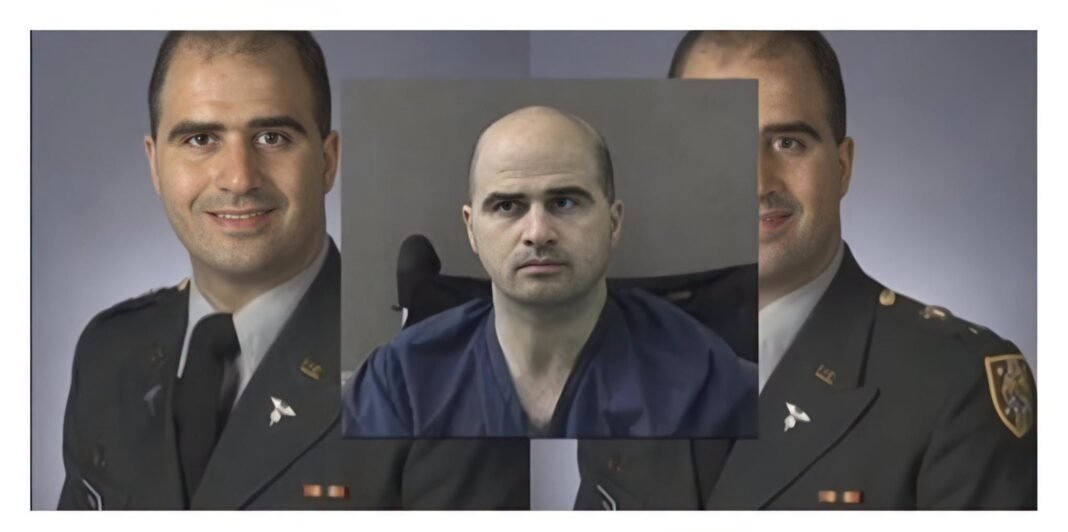
Washington, World Affairs Desk | WEBVARTA
Nidal Malik Hasan Execution:
The US military’s plan to livestream the scheduled execution of Nidal Malik Hasan, the former Army psychiatrist convicted in the 2009 Fort Hood shooting, has brought renewed attention to the legal, ethical and procedural questions surrounding capital punishment. The execution is scheduled for December 3, 2026, at Fort Hood, Texas, and is expected to be carried out by firing squad, subject to any further legal developments.
The US Department of Defense confirmed on October 8 that the execution would be livestreamed. The announcement followed public remarks by Defense Secretary Pete Hegseth, who said the event would be made accessible for people to watch. The proposed broadcast would make an already rare military execution the centre of a wider discussion about transparency, the treatment of condemned prisoners and the public presentation of state punishment.
- Person: Nidal Malik Hasan
- Execution date: December 3, 2026
- Location: Fort Hood, Texas, United States
- Planned method: Firing squad
- Broadcast plan: Livestream, according to Pentagon officials
- Original shooting: November 5, 2009
- Conviction: 2013 military court-martial
- Casualties: 13 people killed and 32 injured
Nidal Malik Hasan Execution: Why the Livestream Matters
The planned broadcast introduces a significant public dimension to a process normally conducted under tightly controlled conditions. Although the government has confirmed the livestream, detailed information about how it will operate, who will be permitted to watch and what safeguards will apply has not yet been fully outlined.
Hegseth discussed the public nature of the execution during an interview with Real America’s Voice. Pentagon officials subsequently clarified that the event would be livestreamed, with further arrangements to be announced.
The decision raises questions about the purpose of broadcasting an execution. Supporters of greater transparency may argue that public access allows people to understand how capital punishment is administered. Critics, however, may question whether broadcasting a death sentence risks turning a judicial process into a public spectacle.
The debate is not limited to the proposed broadcast. It also involves the responsibilities of military authorities, the rights and dignity of the condemned prisoner, and the standards expected when the state carries out a sentence of death.
Legal Experts Differ on Public Access to Executions
Legal specialists have identified competing considerations in the debate over a livestream. Deborah Denno, a Fordham University law professor who studies the death penalty, has argued that greater visibility could help the public understand the realities of capital punishment.
That argument centres on transparency: a process carried out by the state should be open to appropriate scrutiny, particularly when it involves an irreversible punishment. Public access, however, does not by itself settle questions about whether a particular execution method is lawful or whether the procedures have been properly followed.
Elisabeth Semel, co-director of the Death Penalty Clinic at UC Berkeley Law, has raised concerns about the government’s decision to initiate a broadcast. Issues include the purpose of the livestream, the dignity of the person being executed and the broader social consequences of making the event publicly viewable.
Another perspective comes from Brenner Fissell, a Villanova University law professor and vice president of the National Institute of Military Justice. The wider debate over execution methods, he has noted, includes arguments about the practical difficulties associated with lethal injections and the use of alternative methods such as firing squads.
Could a Court Challenge Change the Execution Date?
The December 3 date is an official schedule, but further legal proceedings could affect the timetable. One possible route discussed by military law specialists is a habeas corpus petition in a civilian court. Such a petition asks a court to examine whether a person’s detention or continued custody is lawful.
Hasan’s conviction and death sentence have already passed through the military appellate process. The US Army stated that the Supreme Court declined to review his court-martial conviction in March 2025. That procedural history does not, by itself, resolve every question that might arise in connection with the implementation of the sentence.
Any new filing would have to meet the relevant legal requirements. A petition would not automatically stop an execution; its effect would depend on the grounds raised and any orders issued by the court.
It remains uncertain whether Hasan will pursue further legal action. His conduct during his trial, including his decision to represent himself, has contributed to uncertainty about his intentions, but it would be premature to treat that past conduct as proof of what he will do next.
What Happened in the 2009 Fort Hood Shooting?
On November 5, 2009, Hasan entered a medical processing facility at Fort Hood, where military personnel were undergoing procedures connected with medical clearance and deployment. He opened fire, killing 13 people and injuring 32 others.
Hasan was an Army psychiatrist and held the rank of major. He was prosecuted by a military court and convicted in 2013. The court-martial jury subsequently imposed a death sentence after finding him guilty of the charges brought against him.
During the proceedings, Hasan said he had acted to prevent soldiers from deploying to Afghanistan and killing fellow Muslims. The military judge did not allow that argument to be presented as a legal defence. Hasan was shot by law enforcement during the incident and was left paralysed from the waist down.
Dispute Over Access to Legal Counsel
Questions have also emerged over the process used to notify Hasan that the execution had been approved. John Galligan, a former military judge who represented Hasan in civil matters after the criminal trial, said Hasan had told him that no attorney was physically present when the notification was delivered.
Galligan questioned whether the notification procedure complied with Army rules and expressed concern about Hasan’s access to legal advice. His account represents one side of a disputed procedural issue.
An Army spokesperson offered a different account, saying officials had made multiple attempts to contact military defence attorneys and had followed the applicable procedures. The spokesperson also said Hasan had not been prevented from contacting or communicating with his lawyers.
The competing statements leave questions about the notification process that must be assessed against the relevant military regulations and any evidence presented through legal proceedings. A reported disagreement over procedure should not, on its own, be treated as a judicial finding that the rules were violated.
Military Execution History and the Firing Squad
The scheduled execution would be an unusual event in the modern history of US military justice. The US Army has identified April 13, 1961, as the date of its most recent military execution, when Army Private John Bennett was executed by hanging.
The military’s last use of a firing squad for an execution dates to the period shortly after the Second World War. If Hasan’s execution proceeds as scheduled, it would therefore represent a rare return to a method that has not been used by the US military for decades.
The choice of method has drawn attention amid a wider American debate about the administration of capital punishment. Lethal injections have faced practical difficulties in some jurisdictions, including problems obtaining execution drugs and securing the participation of medical personnel. Those concerns have contributed to renewed discussion of alternative methods, although their use raises separate legal and ethical questions.
| Date | Key development |
|---|---|
| November 5, 2009 | The Fort Hood shooting leaves 13 people dead and 32 injured. |
| August 2013 | Hasan is convicted by a military court and sentenced to death. |
| March 31, 2025 | The US Supreme Court declines to review Hasan’s court-martial conviction. |
| October 2026 | The death sentence is approved and the Army sets an execution date. |
| December 3, 2026 | Execution by firing squad is scheduled at Fort Hood, subject to legal developments. |
Public Executions in the International Context
The proposed broadcast has also prompted comparisons with public executions elsewhere. Amnesty International’s figures for 2025, cited in reporting on the issue, recorded at least 17 public executions in Iran and Afghanistan combined.
Those figures provide international context, but different countries operate under different legal systems and execution practices. The comparison does not establish that the cases are equivalent; it highlights the wider question of how governments make the use of capital punishment visible to the public.
In the United States, the Hasan case brings that question into a military setting, where the execution process is governed by specific regulations and the sentence follows a court-martial conviction.
What Happens Before December 3?
The next developments will depend on the arrangements announced by the Pentagon, any legal steps Hasan takes and decisions made by the courts. Officials have said that more information about the livestream will follow, but the practical details have not yet been fully explained.
The Army’s scheduled date remains December 3, 2026. Any legal filing, court order or change in the official arrangements could affect what happens next. Until then, the broadcast plan remains a proposal announced by the authorities rather than a completed event.
- The Pentagon is expected to provide further details about the planned livestream.
- Hasan may pursue additional legal proceedings, although his intentions remain unclear.
- Any court order could affect the scheduled execution date.
- The decision is likely to keep attention on military execution procedures, public access and the ethics of capital punishment.
The Hasan case now raises questions that extend beyond the scheduled execution itself. The implementation of a military death sentence, the transparency of government procedures and the decision to broadcast an execution are distinct issues, each carrying legal and ethical implications. The coming weeks will determine whether the plan proceeds as announced or is affected by further legal developments.