
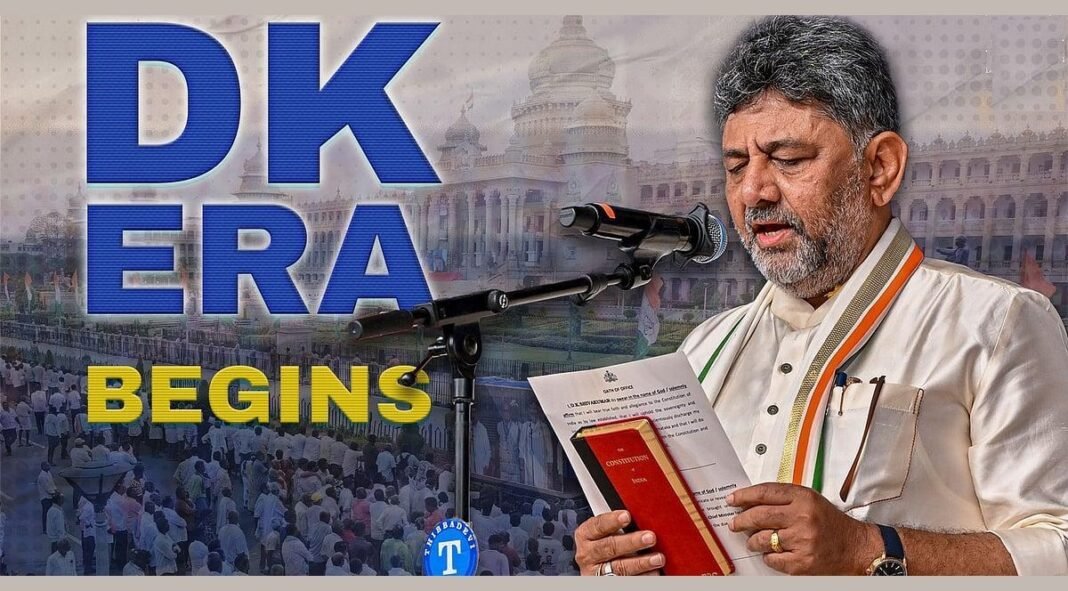
DK Shivakumar is fast & furious : In a smart symbolical move he touches Gen Z politics – with administrative firmness & urgency, makes it youth-centric policy making sop. Just in a day in office he sends a direct message to his rivals and supporters : His government intends action and governance with purpose. This is in contrast to theatrics! No jumlabazi!
Just before taking the oath of office, Shivakumar bowed before the people of Karnataka, acknowledging the trust placed in him by millions of voters. Holding the Constitution in his hand and dressed in traditional attire, he took the oath amidst a ceremony rich in Kannada cultural symbolism and attended by senior Congress leaders, ministers, and dignitaries. The symbolism did not end there. Soon after the swearing-in ceremony, the new Chief Minister visited Vidhana Soudha, where he paid tribute to Dr. B.R. Ambedkar, Basavanna, Nadaprabhu Kempegowda, Jawaharlal Nehru, and Mahatma Gandhi. In a gesture that resonated with many Kannadigas, he bowed before the steps of the legislature building before formally assuming charge. Within hours of taking office, Shivakumar convened his first Cabinet meeting and unveiled what he described as the beginning of a “Youth Era” in Karnataka. The government announced a series of ambitious initiatives aimed at students and young professionals. Among the headline decisions was free bus travel for all school and college students on non-luxury government buses, a move expected to ease the financial burden on families across the state. The administration also announced plans to fill 56,000 vacancies in government departments and establish a state-supported private employment exchange to connect young job seekers with opportunities in the private sector.
In a ambitious youth outreach initiative, the government proposed the creation of 10,000 youth associations across Karnataka. Each association is expected to receive financial support of Rs 10 lakh to promote sports, cultural activities, leadership development, and community participation. The Cabinet also focused on long-standing urban issues. Thousands of homeowners struggling with Occupancy Certificate (OC) and Completion Certificate (CC) disputes received relief through a one-time regularisation measure.
The government further announced plans to convert B-Khata properties into A-Khata across the state, potentially benefiting lakhs of property owners. For Bengaluru’s infrastructure woes, the Chief Minister earmarked Rs 2,000 crore for road resurfacing and development projects not covered under existing schemes.
Bureaucracy Put on Notice
The second day of the new administration witnessed a strong push towards governance and accountability. Addressing senior IAS, IPS, and Forest Service officers, Shivakumar instructed officials to function without political, caste, religious, or external pressures. He called for transparent, citizen-centric, and corruption-free governance. All departments have been directed to submit detailed action plans within fifteen days, along with reports on pending projects and vacant positions. The Chief Minister also announced plans to establish two new ministries — one dedicated to Public Grievances and another for Non-Resident Indians (NRIs). The move is intended to strengthen citizen engagement while leveraging the economic and intellectual contributions of Kannadigas living abroad.
Expressing concern over the ongoing revision of electoral rolls, Shivakumar instructed officials to ensure that no eligible voter is disenfranchised due to procedural hurdles. Awareness campaigns and facilitation centres are expected to be launched across districts to assist citizens. On the law-and-order front, the government has proposed dedicated taluk-level squads to monitor and curb criminal and rowdy activities, signalling a tougher stance on public safety. The administration is also exploring ways to utilise nearly Rs 8,000 crore available under Corporate Social Responsibility (CSR) initiatives, with education and healthcare emerging as key focus sectors.
The policy announcements reflected a government eager to establish momentum. Whether it is jobs, youth empowerment, urban development, electoral vigilance, or administrative reforms, the new Chief Minister has made one thing clear: The DKS government wants to be judged not merely by promises, but by the speed with which it implements each word typed in the government document. Here at 10 Janpath in Delhi expectations are very high from DKS. The high command wants DK Shivakumar to set an example for most of the Chief Ministers in various states of India.