

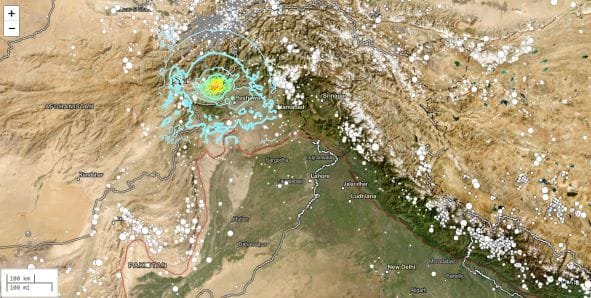
New Delhi/Kabul, (Web Varta) – A powerful 6.0 magnitude earthquake struck 36 kilometers north of Basawul in Afghanistan’s Nangarhar province on Sunday night, sending tremors across Delhi-NCR and other parts of northern India. The quake, centered at a shallow depth of 10 kilometers, occurred at 7:17 PM UTC on August 31 (12:47 AM IST on September 1). This disaster comes as northern India is already reeling from severe flooding and landslides, adding to the region’s woes and sparking widespread fear among residents.
The earthquake hit at a time when northern India is grappling with the aftermath of record-breaking rainfall in August. The India Meteorological Department (IMD) has warned of above-normal rainfall in September, raising concerns about flash floods, landslides, and cloudbursts. The tremors have now compounded the challenges, making relief efforts more complex for the already beleaguered region.
Earthquake Details: What Happened and Where?
According to the United States Geological Survey (USGS), the earthquake registered a magnitude of 6.0, with its epicenter located 36 km north of Basawul in Nangarhar province. The shallow depth of 10 km amplified the intensity of the tremors felt across the region. While no major damage or casualties have been reported in Afghanistan so far, local media noted that buildings shook, prompting residents to rush out of their homes in panic.
In northern India, tremors were felt in Delhi-NCR, Punjab, Haryana, Uttarakhand, and Jammu and Kashmir. Residents reported being jolted awake in the middle of the night, with many fleeing their homes. Social media platforms buzzed with accounts of the event, with one user posting: “First floods destroyed our homes, now an earthquake has left us terrified!” Experts note that the Hindu Kush region is prone to seismic activity, but the intensity of this quake has heightened concerns.
Flood Crisis: Record Rainfall in August, September Threat Looms
Northern India is already in the grip of a severe flood crisis. August saw 265 mm of rainfall in northwest India, the highest since 2001. In Jammu, the Tawi River overflowed, destroying homes, while Uttarakhand and Himachal Pradesh reported over 36 deaths due to landslides. According to Al Jazeera, heavy rains on August 27 claimed at least 30 lives, with several others missing.
The IMD has forecasted 109% above-normal rainfall for September, increasing the risk of flash floods and landslides in Uttarakhand, Haryana, and Punjab. Meteorologists warn: “This is the impact of climate change, with rainfall intensity rising in the Himalayan region.” Areas like Vaishno Devi have seen pilgrims stranded due to flooding, and the earthquake has further complicated ongoing relief efforts.
Impact on People: Floods Followed by Earthquake Fear
For residents of northern India, this is a double blow. August’s floods displaced thousands, destroyed crops, and blocked roads. Now, the earthquake has left people sleepless and anxious. A local resident shared: “We were just recovering from the floods when the ground shook. What’s happening this year?” The government has intensified relief operations, but experts caution that more natural disasters could strike in the coming days.
On X (formerly Twitter), users shared their experiences using hashtags like #FloodIndia and #Earthquake. One post read: “30 deaths from flash floods in northern India, now an earthquake!” Relief agencies are on high alert, urging residents to remain vigilant.
What Experts Say
Seismologists explain that the Hindu Kush region is a hotspot for tectonic plate collisions, leading to frequent earthquakes. A 5.2 magnitude quake struck the same area on August 19. The IMD warns that September’s heavy rainfall could exacerbate seismic risks. Residents are advised to stay in sturdy buildings and keep emergency kits ready.
This event underscores the combined threats of climate change and geological activity, putting regions like northern India and Afghanistan at high risk. Governments and international agencies are mobilizing relief efforts, but authorities urge the public to exercise caution.
🌍 Earthquake Update:
From floods to quakes, nature is on a rampage! ⚡
👉 Tremors felt across Northern India including Delhi-NCR.
🌍Magnitude 6.0 earthquake struck 36 km North of 📍Basawul, Afghanistan.
🕒 31 Aug | Depth: 10 km#earthquake #DelhiNCR #Flood #NaturalDisaster— Webvarta News Agency (@webvarta) August 31, 2025
अफगानिस्तान में 6.0 तीव्रता का भूकंप, उत्तरी भारत में झटके; बाढ़ के बाद नई आफत!