
New Delhi, World Affairs Desk | WEBVARTA
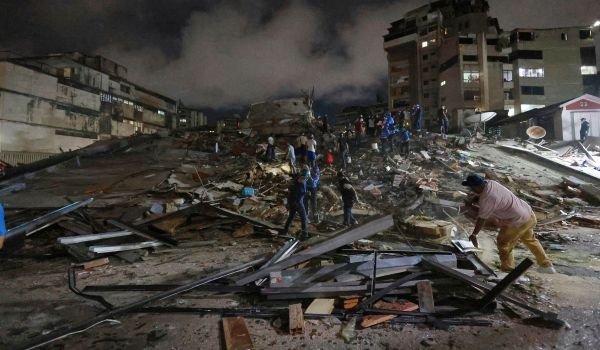
Venezuela Earthquake Death Toll has climbed to 235 as rescue teams continue searching for survivors after two powerful earthquakes devastated parts of the country. More than 1,500 people have been injured, while emergency responders remain engaged in intensive rescue operations following the twin earthquakes that struck near the Venezuelan capital. Authorities say many people are still feared trapped beneath collapsed buildings as teams race against time to locate survivors.
The powerful seismic event triggered widespread destruction in Caracas and the nearby coastal city of La Guaira, where residential buildings, commercial structures, and public infrastructure suffered extensive damage. Eyewitnesses reported hearing desperate cries for help from beneath the debris as emergency crews worked around the clock using heavy equipment and search-and-rescue dogs.
According to officials, the first earthquake measured 7.2 in magnitude and was followed within seconds by an even stronger 7.5-magnitude quake. Both earthquakes occurred at a shallow depth, significantly increasing the intensity of ground shaking and resulting in severe structural damage across affected areas. Acting President Delcy Rodríguez has declared a nationwide state of emergency as rescue and humanitarian efforts continue.
📌 Quick Info
- Country: Venezuela
- Death Toll: 235
- Injured: More than 1,500
- Major Earthquakes: Magnitude 7.2 and 7.5
- Worst-Hit Areas: Caracas and La Guaira
- Current Status: Rescue operations continue
- Emergency Declaration: State of Emergency announced
Venezuela Earthquake Death Toll Continues to Rise
The humanitarian crisis in Venezuela has intensified as officials confirmed that the Venezuela Earthquake Death Toll has risen to 235. Rescue personnel continue to search through damaged buildings where many victims are believed to remain trapped.
Emergency services have deployed specialized rescue teams equipped with heavy machinery, medical personnel, and trained search units. Authorities say the first 72 hours following a major earthquake remain critical for locating survivors, prompting continuous rescue operations despite challenging conditions.
Hospitals in the affected regions continue treating hundreds of injured residents, while temporary shelters have been established for families displaced by the disaster.
Twin Earthquakes Trigger Massive Destruction
Seismologists reported that the first earthquake measured 7.2 on the Richter scale before being followed almost immediately by an even stronger 7.5-magnitude tremor.
Because both earthquakes originated at a relatively shallow depth, the shaking was significantly more destructive than deeper seismic events. Buildings in Caracas and the coastal city of La Guaira sustained severe damage, with several structures collapsing completely.
Residents described moments of panic as roads cracked, electricity supplies were disrupted, and emergency sirens echoed across affected neighborhoods.
| Key Information | Details |
|---|---|
| Country | Venezuela |
| First Earthquake | Magnitude 7.2 |
| Second Earthquake | Magnitude 7.5 |
| Confirmed Deaths | 235 |
| People Injured | More than 1,500 |
| Worst-Affected Areas | Caracas and La Guaira |
| Government Response | State of Emergency declared |
Shallow earthquakes generally cause much stronger ground shaking because seismic energy travels a shorter distance before reaching the surface. When powerful earthquakes occur near densely populated urban centers, the risk of widespread structural collapse, casualties, and infrastructure damage increases significantly, making rescue operations more challenging.
State of Emergency Declared Across Venezuela
Acting President Delcy Rodríguez declared a state of emergency following the devastating earthquakes to accelerate rescue operations and mobilize national resources.
The emergency declaration allows authorities to deploy additional rescue personnel, healthcare workers, emergency funding, and disaster management resources to affected regions. Officials continue to coordinate relief operations while assessing damage to roads, hospitals, public buildings, and essential infrastructure.
Authorities have urged residents to remain cautious due to the possibility of aftershocks, which frequently follow major earthquakes and can further weaken already damaged structures.
International Community Offers Humanitarian Support
Several countries have pledged humanitarian assistance as Venezuela responds to one of its deadliest natural disasters in recent years.
Acting President Delcy Rodríguez acknowledged India’s expression of solidarity following the tragedy and welcomed Prime Minister Narendra Modi’s message conveying condolences to the victims and their families. She expressed gratitude for India’s willingness to support ongoing relief efforts, describing the gesture as a reflection of the strong spirit of cooperation between the people of both nations.
International humanitarian assistance is expected to include emergency medical aid, rescue equipment, relief supplies, and logistical support as recovery efforts continue.
Rescue Teams Continue Race Against Time
Search-and-rescue teams remain focused on locating survivors trapped beneath collapsed buildings in Caracas and La Guaira. Heavy machinery, rescue dogs, drones, and specialized equipment are being used to search damaged structures while emergency medical teams provide immediate treatment to rescued victims.
Humanitarian organizations are also working to provide temporary shelter, food, drinking water, and medical care to thousands of displaced residents affected by the disaster.
The rising Venezuela Earthquake Death Toll highlights the scale of the humanitarian crisis facing the country. Continued international assistance, coordinated rescue operations, and long-term reconstruction efforts will be essential for restoring damaged communities, rebuilding critical infrastructure, and supporting thousands of families affected by the disaster.
Conclusion
The Venezuela Earthquake Death Toll has risen to 235 as rescue teams continue searching for survivors following the powerful twin earthquakes that struck near Caracas. With more than 1,500 people injured and extensive damage reported across affected regions, emergency responders remain engaged in life-saving operations while governments around the world extend humanitarian support. As recovery efforts continue, the focus remains on rescuing survivors, assisting displaced families, and rebuilding communities devastated by the disaster.